A descaling joint on a continuous caster was replaced three times in nine weeks. Each report said seal failure. The fourth joint came back to us with radial grooves deep enough to catch a fingernail, and the plant water analysis looked fine. The inlet filter had been bypassed during a shutdown two years earlier and never put back.
Descaling water is the hardest duty a rotary joint sees in a steel plant, and it is hard for three reasons simultaneously. Pressure: 10-30 MPa on a conventional descaling header, 40-70 MPa on high-intensity lines, above 100 MPa on water-jet cleaning. Particles: the water comes from a circulation tank and carries mill scale. Shock: every jetting cycle ends with a valve closing.
There is a fourth detail that catches people out on casters: the joint often does not rotate at all. It oscillates through 30 to 60 degrees as the segment swings, so the seal wears a sector rather than a full track. A face that looks half used after a year is not half worn, it is worn through in one arc while the rest is still lapped.
Size on pressure alone and you get a joint that is expensive and still fails. The scale arrives with the water and the shock arrives with the valve.
A 25 MPa pump can put 40 MPa into a joint when a fast-closing valve stops the flow, because the column of water has nowhere to go. That spike cracks faces. The steady 25 MPa only wears them.
Our range goes to 138 MPa. That is a ceiling for the product line, not a target for every order, and buying the top class for a 12 MPa line just moves money from the maintenance budget to the capital budget. Ask the plant for the peak off the pressure trace, not the operating point on the HMI screen. If no trace exists, assume 1.5 times the pump rating and call us before the order goes in.
Accumulators and slow-closing valves cut the spike, and they are usually cheaper than the next pressure class up. Fit the accumulator, then still buy the joint rated above the residual peak.
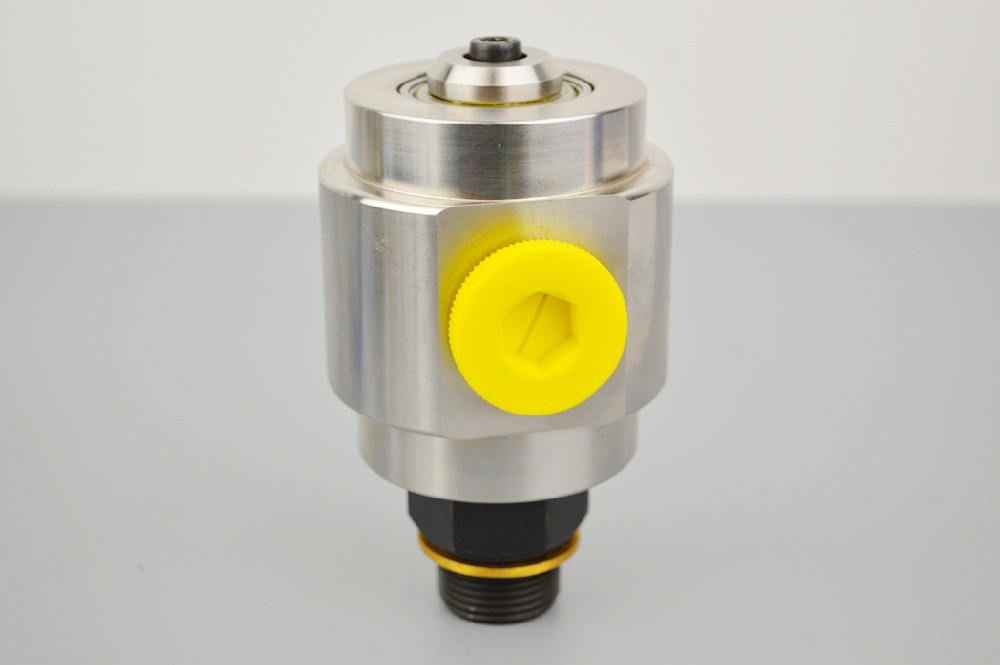
DEWEL 35 MPa high-pressure rotary joint (1)
Add up the flow of every nozzle on the header. Divide by a velocity of 3-5 m/s. That gives the bore, and for high-pressure low-flow descaling it usually lands between DN10 and DN25.
Resist going one size up for safety. A larger bore drops pressure at the nozzle, which is the one place you need it, and adds cost and envelope at the joint. One size down raises velocity, and at 8 m/s in scale-laden water the bore erodes from the inside out.
The range covers DN6 to DN350, so the descaling header and the large-bore cooling water run further down the line can come from the same supplier and still be sized separately, on their own numbers.
SiC against SiC is the right face pair for descaling water, and it is no substitute for a filter. Hard faces resist erosion. They do not resist a 200 micron particle being dragged across them under pressure a million times.
Two things make the difference in the field. A filter at the inlet, 100-200 micron, with a differential gauge and a blowdown schedule somebody actually follows. And a flushing port on the joint, feeding a small filtered flow across the seal area so scale never settles in the seal chamber.
When a customer asks for a longer-life joint, the honest answer is often "keep the filter clean", not "buy the higher grade". A filter element costs less than one ring set, and the ring set costs less than the four hours of line stoppage it takes to change it.
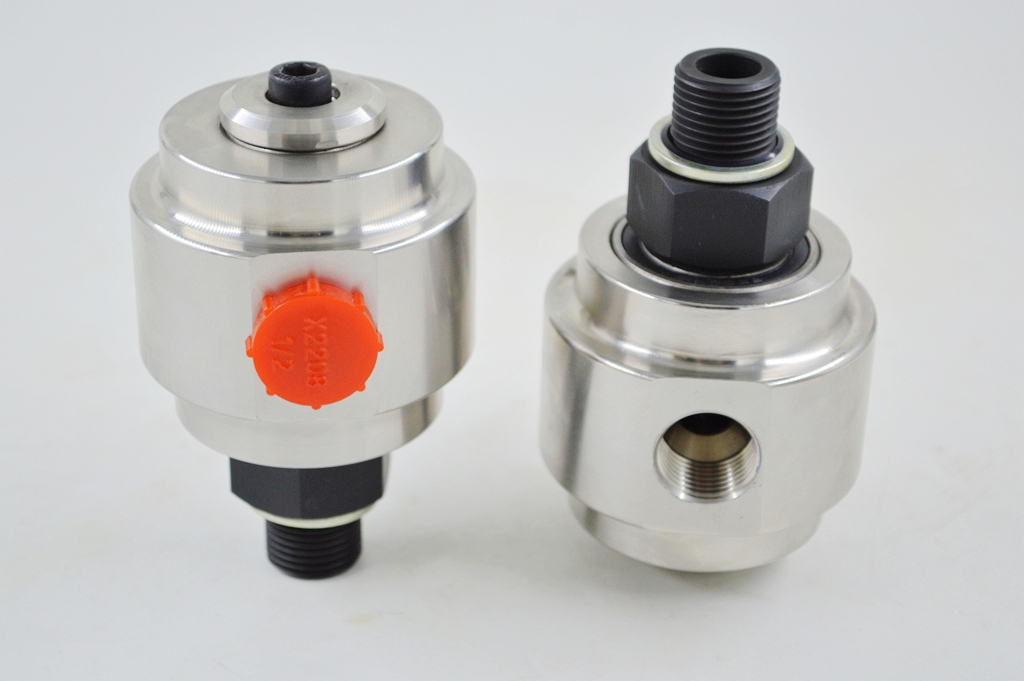
DEWEL 35 MPa high-pressure rotary joint (2)
Put the leak position next to the pressure trace. A leak that starts the moment the valve closes is a shock problem. A leak that grows over weeks is erosion. Different causes, different people to fix them.
One page is enough if it carries six lines: medium and particle content, operating and peak pressure, total nozzle flow and required bore, speed or swing angle, mounting and connection dimensions, and whether flushing or cooling water is available.
With those we confirm a standard model or quote a custom one without a second round of questions. Without them the only honest answer is a range, and a range is how a DN25 joint ends up on a DN15 line.
Every joint is built in Tengzhou, Shandong, under ISO 9001 certified in 2013, with CCS type approval since 2017. The company was founded in 2010, with engineering experience dating back to 2006, which matters on casters that have been rebuilt twice. Standard high-pressure models are on the high-pressure rotary joint page, and anything off-drawing goes through custom engineering.
Related: Thermal oil joints for hot rollers and Seal face materials: graphite, SiC and PTFE.
11-17,2026
GB/T and JB/T test methods belong in acceptance clauses. ISO...
11-13,2026
Graphite, silicon carbide and filled PTFE faces wear in very...


