PUBLISHED ON:
11-23,2026
The most common call we take starts the same way: "the joint is leaking again." Where it leaks tells you what to fix. Twenty minutes of inspection often saves a joint that would otherwise be scrapped, because most of the time the part to replace is a seal component, not the whole joint.
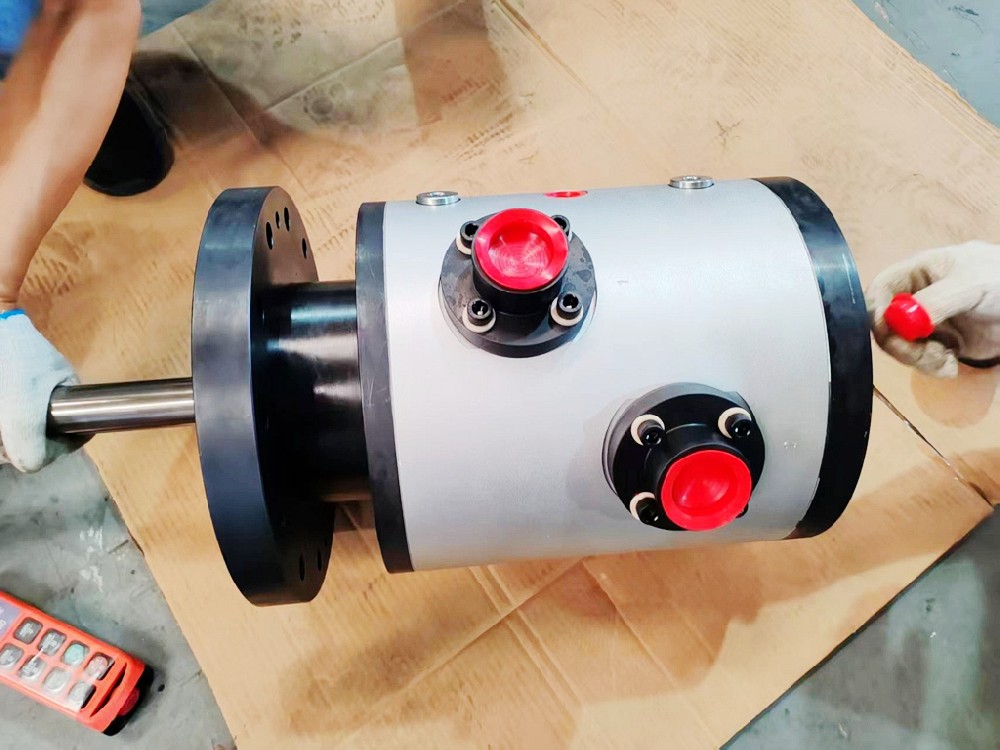
DEWEL clearance-seal rotary joint, photo 1
If the leak is at the shaft end and runs down the shaft, the seal face is involved. Pull the joint apart and look at the carbon ring. Radial scratches across the face mean particles in the media: the filtration is too coarse and works like lapping compound. Replacing the ring alone will not last; go back and fit 10 to 25 micron filtration first.
A face polished flat, chipped at the edge, or showing fine concentric cracks points to dry running and heat. Check two things: whether the spring compensation is stuck, and whether the duty exceeds the rating of that model. Our joints cover DN6 to DN350, up to 138 MPa and 30000 RPM, but these limits are rated by series. Running a low-speed model at high pressure wears the face out in days.
Seepage around the housing cover or plugs is an O-ring problem. On thermal oil service between 180 and 320 C, standard NBR rings harden and crack first, so the leak weeps slowly instead of dripping. Move to FKM; for hotter duty, look at perfluoroelastomer rings.
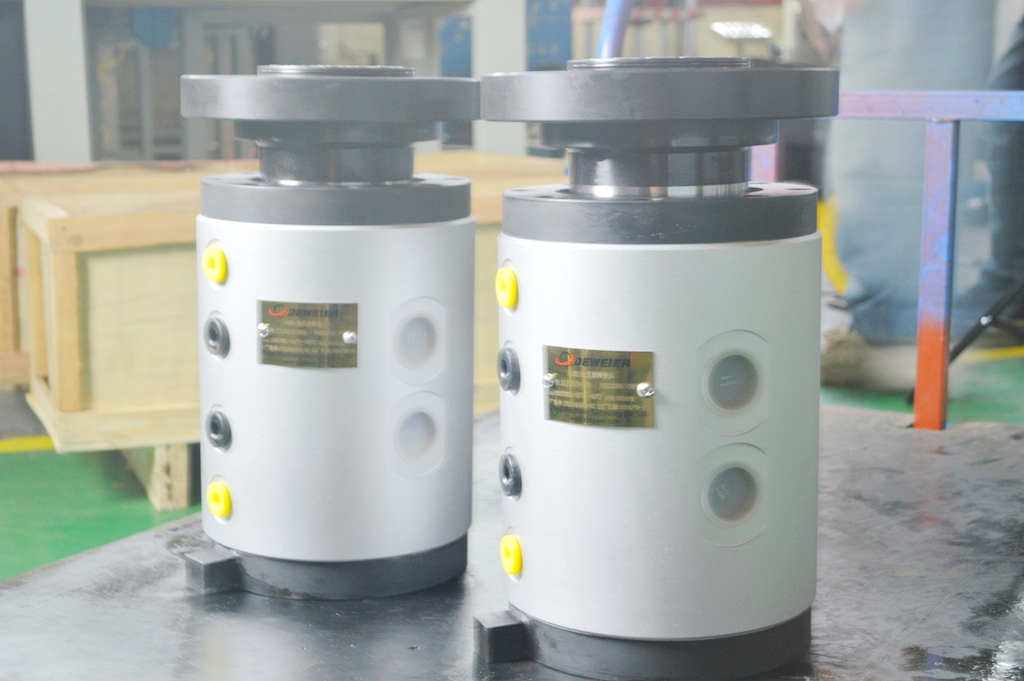
DEWEL clearance-seal rotary joint, photo 2
Swollen, sticky rings mean the media and the elastomer do not match. Water-glycol hydraulic fluid, for example, attacks certain compounds until the groove deforms. Confirm the media grade before ordering replacements.
A joint that leaks after two or three months, and leaks again after replacement, is usually misaligned. Clamp a dial indicator on the housing and rotate the shaft: radial runout above 0.1 mm is too much. The seal face follows the shaft and wears faster. Check the mounting base and the transition shaft, and use a floating mount where possible so the joint finds its own center instead of absorbing shaft runout.
Rigid pipe bolted straight to the ports transfers pipe weight and flange alignment loads into the joint. It shows up often on newly installed machines. Fit a short flexible hose at each port with enough slack, and the bearing and seal assembly stops carrying loads it was never designed for.
In short: locate the leak first. Seal face, O-ring, alignment, pipe stress: work through the four positions, then decide what to replace. When in doubt about selecting a rotary joint, send us the media, pressure, speed and bore. We build joints from DN6 to DN350 and check the drawing against the duty before you order, which is far cheaper than reworking a failed installation.
Related: spindle coolant rotary joints, dual-circuit rotary joints, single-passage rotary joints, hydraulic slip rings.
More reading: Most rotary joint failures start on the order form, Spindle coolant joints fail on filtration, not pressure
11-23,2026
Four leak positions on a rotary joint: seal face, O-ring, mo...
11-19,2026
How to count passages, keep oil, air and coolant apart, and ...