PUBLISHED ON:
11-24,2026
Blade pitch on a wind turbine, a mooring winch on a vessel and steering gear all face the same problem: oil has to cross a rotating joint. A hydraulic slip ring is the component built for that job.
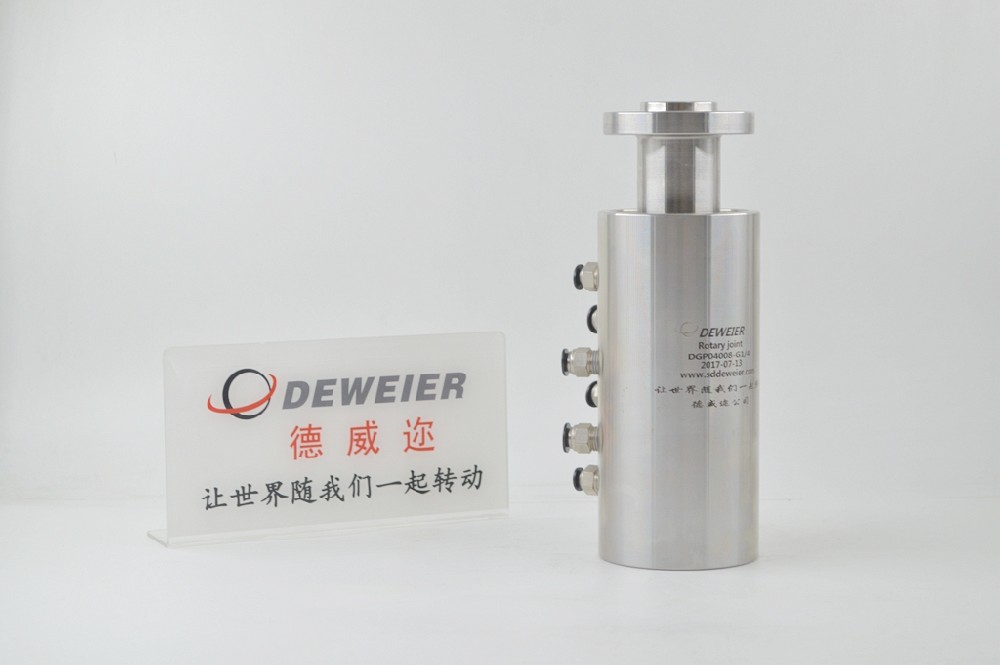
DEWEL multi-passage rotary union
Purchasing teams sometimes order it as a rotary union with extra passages, then run into trouble on site: insufficient pressure rating, crossed passages, or a housing seized by corrosion after one season in salt air. This note breaks the task down by application.
On large hydraulic-pitch turbines, each blade carries its own pitch cylinder, so three working lines plus one spare or return line enter the hub. Hoses that twist with the rotor fail early; a slip ring mounted in the rotor center keeps one side fixed and lets the hub rotate. Speed is low, roughly 10 to 25 rpm, so the key checks are passage count and pressure. Pitch systems typically work around 25 MPa; leave margin above that figure.
Ship winch drums turn well below 200 rpm, yet hydraulic system pressures stay high. DEWEL hydraulic slip rings cover pressures up to 138 MPa, so this duty falls well inside range. Steering gear follows the same logic: the oil line turns with the rudder stock, and even a partial rotation accumulates seal wear. A practical rule: below 200 rpm, fix pressure and passage count first, then check seal face loading. Low speed does not mean low wear.
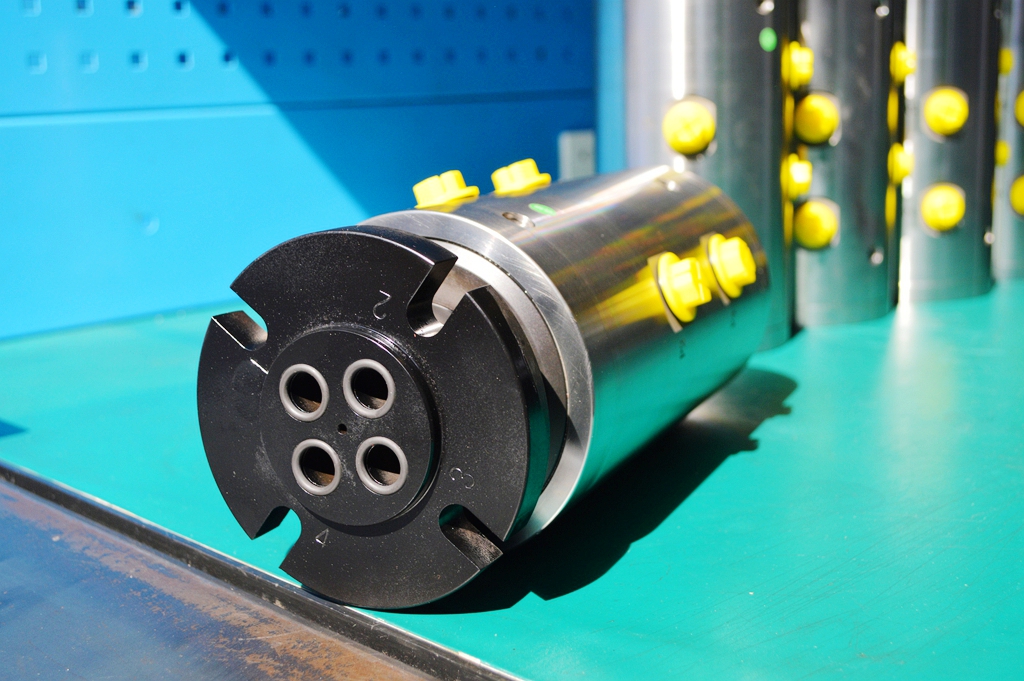
DEWEL multi-passage rotary union unit
Common layouts include several independent lines of the same hydraulic oil, or hydraulic lines combined with signal or lubrication circuits. Cross-passaging makes actuators behave unpredictably, so the passage plan must be fixed on the drawing before manufacturing, not during assembly.
Marine duty demands attention to housing material, fasteners and port fittings. DEWEL holds CCS type certification obtained in 2017, so vessel applications can be checked directly against that scope. Coastal wind farms face the same salt exposure. In cold regions, tell the manufacturer the lowest medium temperature; oil must flow before the seals take load at restart.
Cross-passage leakage usually starts with particle contamination wearing the isolation faces. External leakage often traces to port thread mismatches forced on site. Off-center installation loads the seal faces unevenly; after fitting, turn the shaft by hand and pressure-test before handing over.
Bring these items to the inquiry: media and passage count, working and peak pressure per line, relative speed, shaft diameter and runout tolerance, ambient temperature and salt exposure, port specifications. DEWEL hydraulic slip rings support custom passage layouts, with bore sizes from DN6 to DN350 and pressure up to 138 MPa. See the hydraulic slip ring product page, or compare with central rotary joints and pipeline rotary joints.
Related: One Shaft, Eight Lines: Routing Multi-Passage Joints, Central Rotary Joints: Pick Oil Passages Before Pressure.
11-23,2026
Four leak positions on a rotary joint: seal face, O-ring, mo...
11-19,2026
How to count passages, keep oil, air and coolant apart, and ...