PUBLISHED ON:
11-25,2026
Plenty of catalogs print 30000 rpm on the cover. Few of those joints survive running at 30000 rpm all day. Last month a grinding machine builder asked us why our spindle coolant joint costs more than another brand with the same printed rating. The honest answer: at the rated speed, the joint has to hold up against friction heat and wear, and that comes down to seal face diameter, materials and balancing. Here is how to work out the numbers yourself.
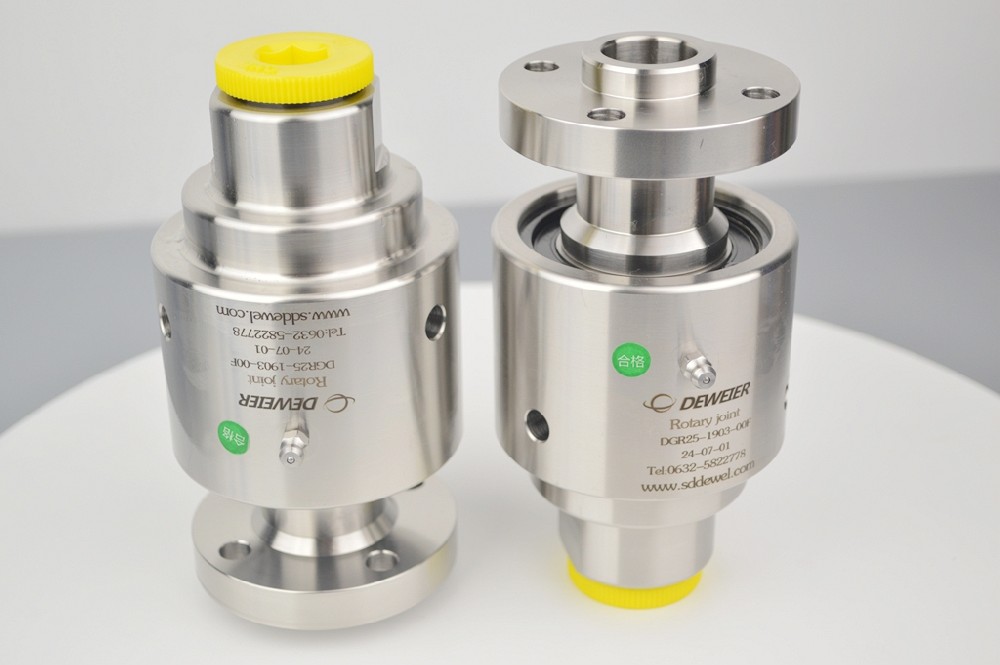
DEWEL high speed rotary joint (1)
A speed rating means nothing on its own; it is tied to seal face diameter. Seal face speed V = pi x D x n / 60, where D is the seal face diameter in meters and n is speed in rpm. At 30000 rpm, a 25 mm seal face gives roughly 39 m/s; a 40 mm face gives 63 m/s at the same speed. Friction pair materials tolerate far higher PV values when flushed with coolant than when running dry, so the allowable speed for one joint changes with the bore size. Our split-type center through coolant joint, finalized in 2019, is rated 30000 rpm at 140 bar precisely because a small bore keeps the face speed down.
Three sources. First, friction heat at the seal face, proportional to face speed and seal pressure. Second, bearing churning heat: double the speed and bearing heat grows close to the square, not in a straight line. Third, throttling of the coolant itself inside the joint; dropping from 7 MPa to atmospheric turns that pressure difference into heat. Stack these up and once the seal face passes its temperature limit, carbon ring wear jumps from a replacement every few months to every few weeks. A practical check: if the joint body runs more than 30 degrees C hotter than the inlet coolant, stop and investigate.
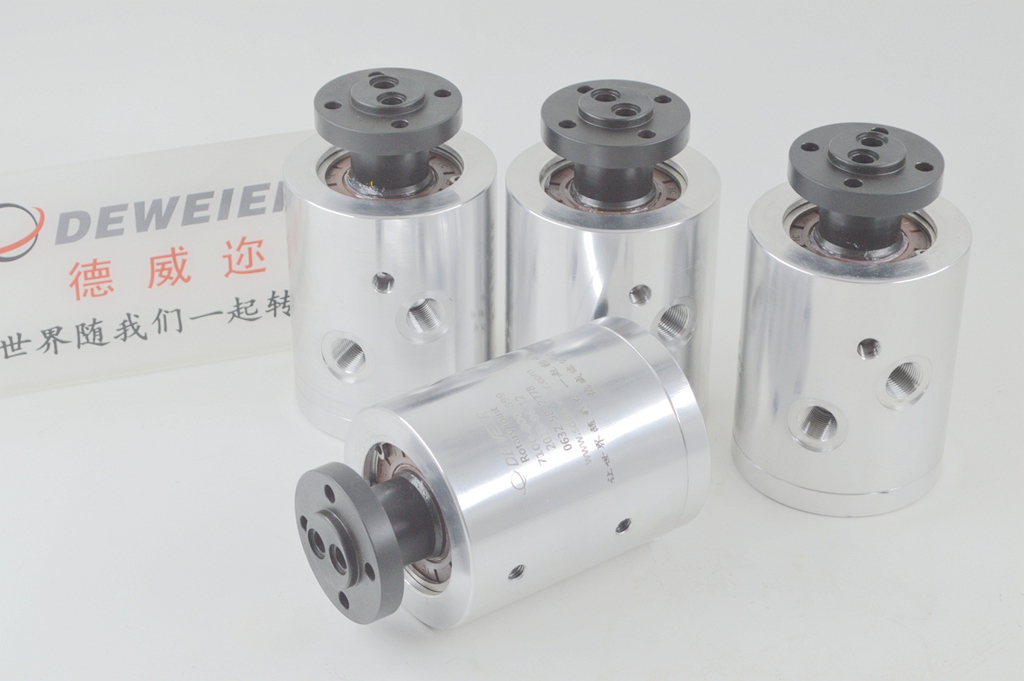
DEWEL high speed rotary joint (2)
Three rules of thumb. Bore size first: running 30000 rpm on a DN10 or larger bore usually means the face speed is past the limit. Stepping down to 12000 rpm brings the face speed to about 16 m/s and multiplies seal life. Filtration second: if the coolant system cannot hold 10 micron filtration, particles embed in the seal face and act as abrasive; higher speed just accelerates the wear. Duty cycle third: a catalog rating is a limit, not a duty. For continuous 24-hour operation, selecting at around 70% of the limit (about 20000 rpm for a 30000 rpm joint) leaves thermal headroom.
The joint rides on the spindle tail, so poor balance shows up as vibration and chatter marks on the workpiece. The internal cavity must be symmetrical, the spring compensation stack has to be evenly arranged, and single-side mass differences on rotating parts must be controlled. On your side the check is simple: after installation, run up to working speed and compare spindle-end vibration with and without the joint. A clear increase means the joint needs rebalancing by the maker.
At the 30000 rpm class, pairs of angular contact ball bearings are standard; preload must restrain axial hydraulic load without overheating. The spring compensation stack keeps the seal faces loaded as they wear, with a travel of 2 to 3 mm to cover a full wear cycle. Both parts have to be sized against media pressure and speed at the drawing stage; they cannot be patched afterwards.
Body temperature rise: keep it under 30 degrees C above inlet. Leakage at the weep port: a center through coolant joint tolerates a slight film of leakage that lubricates the faces, but more than a few drops per minute means stop the machine. Outlet pressure versus the catalog figure: a drop over 15% usually points to internal sealing or a piping problem. Log these three values every shift and the trend shows up within a week. For speed classes and bore options, see the spindle coolant rotary joint range, or send your duty to the engineers behind the rotary joint line for a face speed check; if hot media such as thermal oil is also involved, review the high pressure rotary joint series as well.
Related: Rotary Joint Leaks: Find the Spot Before You Fix It, Hydraulic Slip Rings for Wind Pitch and Ship Winches.
11-25,2026
A 30000 rpm rating means little without seal face speed and ...
11-23,2026
Four leak positions on a rotary joint: seal face, O-ring, mo...